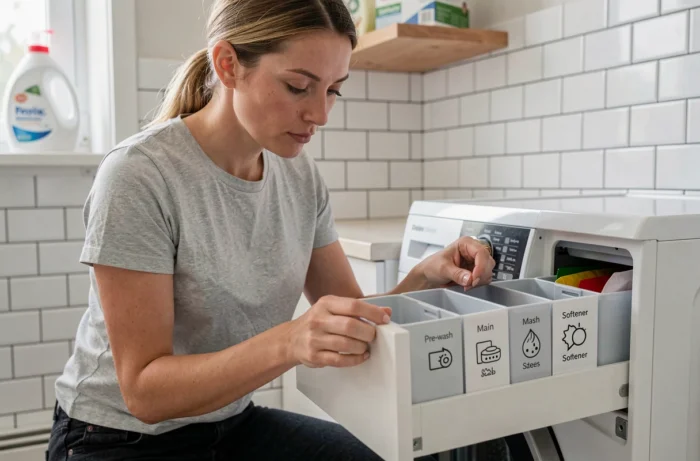
Most washing machine drawers have three compartments, but their markings vary from one manufacturer to another: Roman numerals, letters or symbols. Identifying each compartment and adjusting the detergent dose to the water hardness and laundry load are two separate steps that are often confused. This article examines the gap between common practices and what the machine’s actual operation requires.
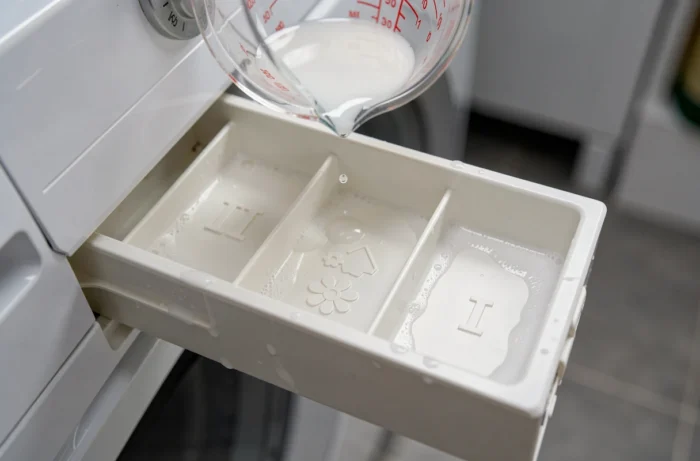
Symbols I, II and flower: what they mean and their role in the wash cycle
The detergent drawer follows a precise mechanical sequence. Water first flows through the prewash compartment, then the main-wash compartment, and finally the fabric softener compartment during the final rinse. Each symbol corresponds to one of these stages.
| Symbol | Other common marking | Cycle stage | Product to use |
|---|---|---|---|
| I | A | Prewash | Detergent (only for heavily soiled laundry) |
| II | B | Main wash | Liquid or powder detergent |
| Flower (or asterisk) | Drop / star symbol | Final rinse | Fabric softener |
The II (or B) compartment is for the main wash. It is the largest of the three compartments on most models. If your drawer has no legible markings, you can still identify the detergent compartment symbol by comparing the compartments’ relative sizes and locating the fabric softener siphon, which has a small tube or cap.
The I compartment (prewash) is only useful for heavily soiled laundry. Using it when it is not needed increases water consumption without any measurable improvement in cleanliness.
White marks on laundry: detergent, limescale or overdosing
Whitish marks on clothes after a wash cycle are the most common sign of a dosing or water-hardness problem. Two causes produce visually identical results but require opposite solutions.
Detergent residue that has not rinsed out
Too much detergent creates excess suds that the rinse water cannot fully remove. The white deposit is then a film of dried surfactants on the fabric. Reducing the dose resolves the problem within one or two washes.
Limescale deposits caused by hard water
In hard-water areas, dissolved limescale settles on the fibres during rinsing. The deposit looks like detergent residue from overdosing, but using less detergent makes the problem worse: fewer surfactants mean less ability to disperse the limescale. In this case, keeping to the recommended dose (or increasing it slightly) and adding a descaler to the main-wash compartment produces better results.
To identify the cause, try rubbing the mark under warm water. Detergent residue dissolves quickly, while limescale deposits persist and require an acidic rinse (diluted white vinegar).
Detergent dosage according to water hardness and laundry load
The dose shown on the packaging generally applies to a standard load and medium water hardness. Three factors may require you to adjust it.
- Water hardness: soft water requires less detergent than hard water. Your local water utility or town hall can provide this information free of charge, often online or on your annual bill.
- Load size: a half load does not require half the dose, but about two-thirds. Detergent pods do not allow this adjustment because they contain a fixed dose intended for a full load.
- Soil level: lightly worn laundry (an office shirt, pyjamas) can be washed with a reduced dose, while sportswear or gardening clothes may call for the maximum dose or even a prewash.
Powder and liquid detergents require different dosing. Powder dissolves less effectively in short cycles or at low temperatures, increasing the risk of residue. Placing the powder directly in the drum using a dedicated dosing device helps it dissolve in quick cycles.
Detergent pods in the drum: a format that limits control
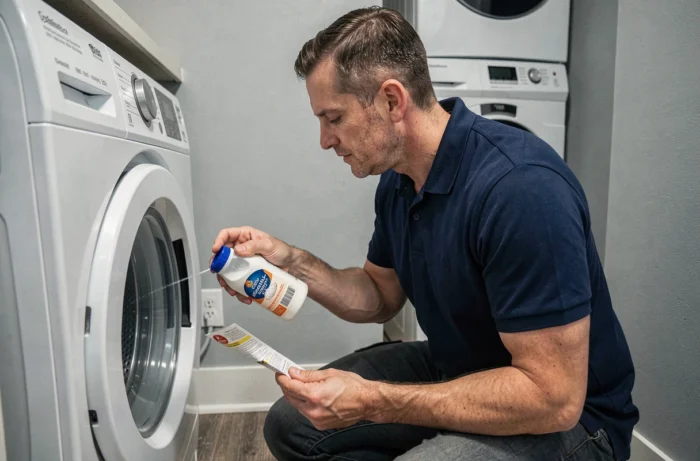
Pods are placed at the bottom of the drum, beneath the laundry, never in the drawer. The detergent is released as soon as it comes into contact with water at the start of the cycle. This works fundamentally differently from the drawer’s water circuit, which carries detergent into the drum at the specific stage set by the programme.
The advantage of pods is their simplicity: no dosing device to clean and no risk of mixing up the compartments. The trade-off is that you cannot adjust the amount of detergent.
- For a small load (less than half a drum), a pod overdoses the wash, which can leave residue and put extra strain on the rinse cycle.
- For heavily soiled laundry, a single pod may not be enough, and there is no way to add extra detergent to the prewash compartment.
- In soft water, the fixed dose often exceeds what is actually needed, meaning you use more detergent than necessary.
Pods are suitable for full loads in medium-hard water. In other situations, liquid or powder detergent offers greater flexibility.
Cleaning the detergent drawer and its effect on dosage
A dirty drawer changes how much detergent actually reaches the drum. Dried detergent residue or hardened fabric softener in the siphon can partially block the flow. The product then remains in the compartment, effectively underdosing the wash despite the correct amount being used.
Remove the drawer by pulling firmly (a safety clip releases when you press the central tab). Cleaning it with hot water every four to six weeks is enough to keep the flow clear. Checking the removable insert in the fabric softener compartment helps prevent overflow that could mix fabric softener and detergent during the wrong cycle.
A blocked siphon can sometimes cause fabric softener to be drawn in during the wash phase instead of the final rinse, reducing its softening effect and potentially affecting the detergent’s cleaning performance.