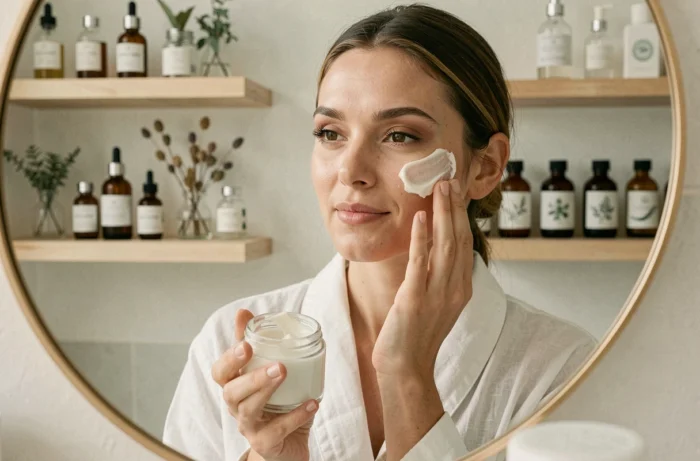
When you open your bathroom cabinet to replace a conventional facial cleanser with an organic version, the first challenge is not finding a labeled product. It’s understanding what the label really guarantees, especially since European regulations are tightening their requirements on ingredients that have long been considered harmless. Building a natural beauty routine today requires a minimum of label reading and some concrete trade-offs.
European restrictions on organic cosmetics: what is changing concretely
Most guides on natural beauty routines stop at parabens and silicones. The regulatory framework is now going further. Since the summer of 2026, the European Commission has notified a draft update of the cosmetic regulation 1223/2009 that targets ingredients commonly found in so-called “green” ranges: cannabidiol (CBD), several benzophenones used as UV stabilizers, the antioxidant BHA, and mercury-containing preservatives.
The draft sets a specific maximum concentration for CBD in cosmetics and removes the last exemptions for mercury preservatives. Manufacturers have 12 to 24 months to withdraw non-compliant products from the market.
At the same time, the European CLP regulation, amended by delegated regulation (EU) 2023/707, introduces specific hazard classes for endocrine disruptors. Online catalogs, such as the Belle et Naturelle site, now feature product sheets that specify compliance with these new requirements, making it easier to sort at the time of purchase.
For consumers, the direct consequence is simple: an organic label does not exempt you from checking the INCI list. A CBD serum purchased a year ago may no longer be compliant today.

Reading the INCI list: spotting ingredients to watch in a natural product
The INCI list (International Nomenclature of Cosmetic Ingredients) appears on every package. Ingredients are listed in descending order of concentration. For a facial cream, water (Aqua) almost always comes first, followed by plant oils or butters in an organic formula.
Three families of ingredients to prioritize
- UV filters and stabilizers like benzophenone: present in some “natural” day creams with sun protection, they are among the substances now restricted by the European update draft.
- Preservatives: the organic label prohibits parabens, but some alternative preservatives (phenoxyethanol, benzyl alcohol) still divide formulators. Feedback on this point varies depending on skin type.
- Synthetic fragrances masked under the generic term “Fragrance”: even in a certified product, this mention can cover allergens. Prefer formulas that detail each aromatic compound.
A useful reflex: compare the length of the INCI list. A short formula with recognizable botanical names (Helianthus Annuus Seed Oil, Aloe Barbadensis Leaf Juice) is generally more transparent than a list of thirty coded components.
Organic facial routine morning and evening: the gestures that really matter
You read everywhere about routines in seven or eight steps. In practice, three gestures are enough for balanced skin. Layering products increases the risk of cross-reactions, especially with concentrated plant actives.
In the morning: cleanse, hydrate, protect
A gentle cleanser (organic gel or micellar oil) removes excess nighttime sebum without stripping. Follow up with a moisturizing treatment suitable for your skin type. For sun protection, this is where the organic choice becomes complicated: mineral filters (titanium dioxide, zinc oxide) sometimes leave a white film, but they remain the only filters allowed in strict organic specifications.
In the evening: remove makeup and nourish
Double cleansing (an oil followed by a water-based cleanser) remains the most effective method for removing makeup and pollution. A serum or facial oil as a finishing touch is sufficient. Jojoba oil is suitable for most combination skin, while argan oil is ideal for dry skin.
No need for a daily mask or a systematic weekly peel. A gentle exfoliating treatment once a week (white clay, rice powder) stimulates cell renewal without being aggressive.

Organic cosmetic labels in France: Cosmébio, Ecocert, Nature et Progrès
The word “natural” on a package does not imply anything legally. Only certified labels impose a verifiable specification. Three labels dominate the French market, and they do not guarantee exactly the same thing.
- Cosmébio: requires a minimum of natural origin components and a percentage of ingredients from organic farming. It is the most widespread label in specialized retail.
- Ecocert: a certifying body that audits brands. An Ecocert certified product adheres to a precise reference on manufacturing processes and the origin of raw materials.
- Nature et Progrès: the strictest specifications. It prohibits synthetic chemistry, including in transformation processes, and imposes environmental criteria throughout the production chain.
Choosing a product bearing one of these labels significantly reduces the risk of greenwashing. Nature et Progrès remains the benchmark for the most demanding formulations, but its offering is more limited.
Vegetable oil, serum, or organic cream: which format to choose for facial care
The product format influences its effectiveness as much as its composition. A pure vegetable oil (argan, jojoba, rosehip) penetrates quickly and is suitable for normal to dry skin. A water-based serum concentrated in plant hyaluronic acid provides hydration for combination skin without a greasy effect.
Organic cream, thicker, combines aqueous and oily phases. It is suitable for skin that needs a protective barrier, especially in winter. You can easily apply a serum under a cream to combine hydration and nourishment, provided the serum is applied first on damp skin.
The choice also depends on the budget. Pure vegetable oils, bought in simple bottles, often cost less than a formulated serum. Starting with an oil and an organic cleanser is enough to test the transition without a heavy investment.
The most effective natural beauty routine is the one you can maintain over time. Three well-chosen products, compliant with the latest regulatory requirements and suited to your skin type, are more effective than a complete shelf of cosmetics accumulated without coherence.