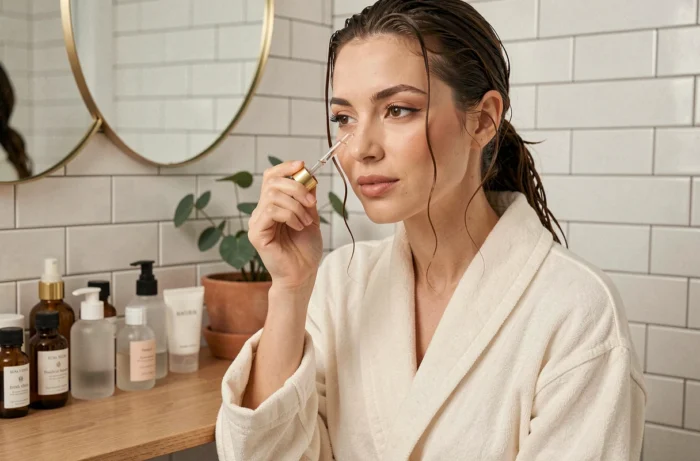
A beauty routine is built on active ingredients, textures, and an order of application. In recent years, formulations have evolved due to new European regulations and a shift towards fewer but more targeted treatments. Understanding these mechanisms allows for coherent product choices that align with the actual state of one’s skin.
Weakened skin barrier: the problem that lengthy routines exacerbate
The layering of concentrated actives (exfoliating acids, retinol, vitamin C) applied daily ultimately disrupts the hydrolipidic film. Dermatologists report an increase in consultations related to irritation and degradation of the skin barrier caused by overly aggressive routines.
The answer is not to stop everything, but to reduce the number of active products and to strengthen basic hydration. Supporting ingredients like ceramides, glycerin, or squalane restore this barrier without causing inflammatory reactions. A single hydrating serum then advantageously replaces three stacked bottles.
This approach, sometimes referred to as skinimalism, is based on a simple principle: fewer aggressive actives, more reparative hydration. Before adding a new treatment to one’s routine, the question to ask concerns the state of the skin barrier, not the product’s marketing promise.
Exploring the entire beauty universe on Owly Mary helps identify treatments formulated around this logic of repair rather than accumulation.
Multifunctional treatments: formulation and selection criteria
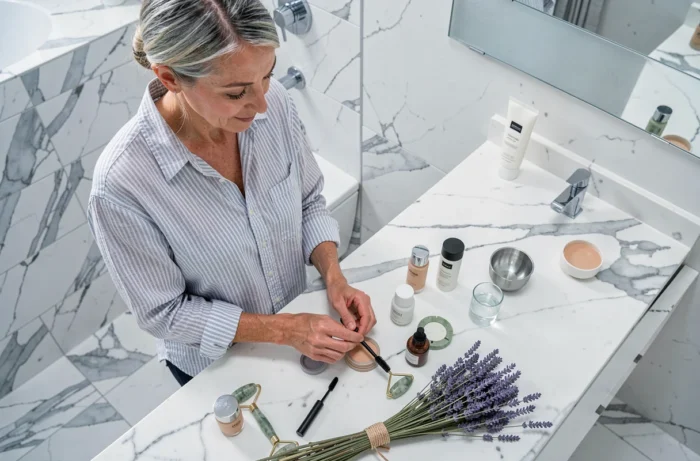
Multifunctionality is not just about slapping three claims on a bottle. It refers to a formulation designed to combine multiple benefits in a single product: hydration, barrier protection, and targeted action (anti-wrinkle, radiance, soothing). Brands that master this approach reduce the number of steps without sacrificing effectiveness.
What distinguishes a true multifunctional product
A credible treatment in this category combines a foundational moisturizing agent (hyaluronic acid, glycerin), a reparative active (panthenol, niacinamide), and a filter or antioxidant depending on day/night use. A well-formulated multifunctional product addresses three needs in one gesture.
Products that merely mix trendy actives without coherent formulation often lead to incompatibilities. Retinol combined with an AHA in the same bottle, for example, increases the risk of irritation without proven benefit.
- Check that the actives are compatible with each other (avoid strong acid + retinol combinations in the same product).
- Favor gel-cream or serum-cream textures that facilitate absorption without a greasy residue.
- Control the position of the main active in the INCI list: if it appears after preservatives, its concentration is likely insufficient.
Cosmetic regulation in France: PFAS and environmental claims
French regulations are tightening the use of PFAS in cosmetics. These perfluoroalkyl substances, long used for their water resistance and smoothing effect, are subject to increasing restrictions that require brands to reformulate certain foundations, setting sprays, and waterproof products.
At the same time, the European Union is implementing a phased withdrawal schedule for microplastics in cosmetic products. Specifically, certain bead exfoliants and some makeup formulas must be modified before the set deadlines.
Green claims: what the AGEC law has regulated since 2022
Since January 1, 2022, the AGEC law regulates formulations labeled as “biodegradable” or “environmentally friendly” on cosmetic packaging. Generic ecological promises have become legally risky for brands that cannot justify them with verifiable data.
For consumers, this means that a product labeled “natural” without third-party certification (Ecocert, Cosmos, Nature et Progrès) offers no real guarantee regarding its composition. Labels remain the most reliable reference to distinguish a genuine commitment from a mere marketing argument.
Hybrid makeup and skincare: the convergence of textures
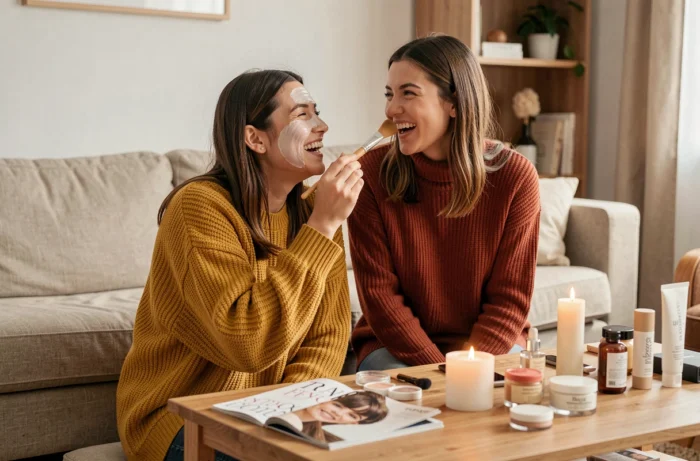
The boundary between makeup and skincare is blurring in recent formulations. Foundations incorporate hyaluronic acid, cream blushes contain hydrating actives, and lipsticks combine pigments with nourishing oils. This convergence meets a specific demand: no longer having to choose between coverage and treatment.
Textures are evolving accordingly. Compact powders are giving way to creamy formulas and tinted gels that blend with the skin instead of sitting on the surface. A well-chosen hybrid makeup actively contributes to skin care.
The selection criterion remains the ingredient list. A foundation that lists occlusive silicones at the top of the formulation does not constitute skincare, even if it contains a moisturizing active at the end of the list.
- Look for tinted bases with niacinamide or squalane for a real skincare effect.
- Avoid hybrid products that combine SPF, anti-aging, and coverage: the concentration of each active is often too low to be effective.
- Test the wear for half a day before replacing a classic foundation: hybrid textures sometimes last less long.
The most effective beauty routine right now does not depend on the number of products or their price, but on the coherence between the state of the skin barrier, the quality of the formulation, and the evolving regulatory framework. Choosing a treatment today involves reading a label with as much attention as a technical sheet.