
Cooking at home is based first and foremost on a simple technical principle: each culinary action (slicing, searing, simmering) requires a tool that is suitable in shape, material, and thermal conductivity. Accumulating utensils is pointless if the fundamentals are lacking. It’s better to have five well-chosen pieces than a drawer full of unused gadgets.
Cooking Materials: Stainless Steel, Cast Iron, and Non-Stick Coating
The choice of material for a frying pan or saucepan determines heat distribution, lifespan, and the type of cooking possible. Three families cover almost all domestic needs.
Stainless steel withstands thermal shocks, does not react with acidic foods, and can go in the oven without restriction. Its average conductivity can be improved with a capped bottom (aluminum or copper sandwich). A 24 to 28 cm stainless steel sauté pan allows for deglazing, making sauces, and searing meat without warping the bottom.
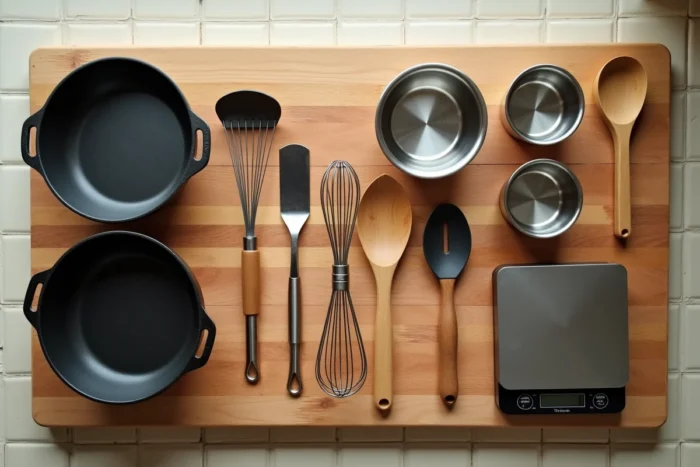
Enamelled cast iron retains heat and releases it slowly, making it suitable for braises, stews, and bread baking. Its weight makes it less maneuverable, but this thermal inertia ensures a stable temperature even when cold ingredients are added.
Non-stick coatings make cooking eggs, pancakes, and delicate fish easier. Their lifespan remains limited, especially beyond 230 °C. Reserving a non-stick pan for gentle cooking extends its longevity by several years. Among the equipment available on À Nos Petits Fourneaux, you can find these different families of materials suitable for everyday use.
Chef’s Knife, Paring Knife, and Cutting Board
A chef’s knife (blade length of 20 to 22 cm) covers most cutting tasks: slicing an onion, chopping herbs, slicing squash. The gyuto shape (Japanese knife with a curved profile) offers a natural wrist motion that reduces fatigue during long cutting sessions.
The paring knife, with its short blade (8 to 10 cm), takes over for precision tasks: peeling an apple, turning a mushroom, removing an eye from a potato. These two knives are sufficient to get started. Adding a serrated bread knife completes the trio without excess.
Blade Maintenance and Sharpening
A well-sharpened knife cuts better and causes fewer accidents than a dull blade that slips on food. A sharpening steel made of steel or ceramic straightens the edge before each cutting session. A medium-grit stone (around 1,000) allows for complete sharpening every two to three months, depending on usage frequency.
The cutting board protects both the blade and the countertop. Hardwoods (beech, maple) absorb shocks without damaging the knife’s edge. High-density plastic is easy to clean but scratches more quickly, which can harbor bacteria over time.
Cooking Hob: Gas or Induction in 2026
The type of hob directly influences energy consumption, thermal responsiveness, and the annual budget. In 2026, the choice between gas and induction deserves reconsideration in light of regulatory developments.
As of July 1, 2026, the CRE’s deliberation has led to a 13% increase in the ATRD on natural gas. For a household that uses gas solely for cooking (around 1,000 kWh per year), this represents an increase of about 5.8% in the annual budget. This pricing trajectory makes gas hobs relatively more expensive to use.
Induction heats only the bottom of the pot through a magnetic field, which reduces thermal losses. The temperature rise is almost instantaneous, and power control is very precise, two concrete advantages for delicate cooking (chocolate, caramel, sauce reduction).
- Gas offers a visible flame and direct sensory feedback, appreciated for wok cooking or dry roasting spices, but its usage cost is rising.
- Induction requires utensils with a ferromagnetic base (simple test: a magnet sticks to the bottom). Pure aluminum or classic copper pots do not work.
- Low-consumption induction hobs represent the dominant trend in domestic equipment, driven by a search for sustainability and control of energy expenses.
Preparation Utensils: Mandoline, Grater, and Scale
The kitchen mandoline produces uniformly thick slices in a fraction of the time needed with a knife. For vegetable gratins, homemade chips, or carpaccios, it ensures even cooking thanks to the uniformity of the cuts. The finger guard provided with most models should never be overlooked.
A Microplane-style grater transforms citrus zest, garlic, ginger, or parmesan into fine particles that blend into preparations without leaving chunks. This tool replaces the traditional garlic press and separate zester, freeing up space in the drawer.
Weighing Rather Than Estimating
The kitchen scale (precision to the gram) eliminates approximation in baking, where the flour/liquid ratio determines the final texture. In savory cooking, it allows for consistent salt measurement from one preparation to another. A reliable digital scale is inexpensive and changes the consistency of results.
Durability and Thoughtful Choice of Kitchen Equipment
The documented trend in 2026 at trade shows dedicated to kitchen equipment confirms a shift towards durable, repairable, and energy-efficient equipment, even among individuals. This movement, directly influenced by professional practices, changes purchasing criteria.
Buying a cast iron Dutch oven that will last for several decades is cheaper in the long run than replacing a low-quality saucepan every two years. Checking the availability of spare parts (handles, seals, lids) before purchase allows for anticipating repairability.
- Favor brands that offer after-sales service and spare parts.
- Choose raw materials (stainless steel, cast iron, wood) rather than composite coatings with a limited lifespan.
- Limit purchases to tools that are actually used each week to avoid clutter and waste.
The right kitchen equipment is not measured by the number of pieces stored in cabinets, but by the actual frequency of use of each. A properly sharpened chef’s knife, a stainless steel frying pan, a cast iron Dutch oven, a mandoline, and a scale cover the vast majority of daily preparations. The rest is more about the pleasure of accumulation than culinary necessity.