Wall decoration is not just about hanging a frame above a sofa. Every choice of covering, finish, or arrangement involves technical parameters that mainstream guides overlook: indoor air quality, substrate compatibility, material weight. Here, we discuss the angles that make the difference between a dressed wall and a truly thought-out wall.
VOC Emissions and Labeling: What the Regulations Change for Wall Paints
Since January 1, 2023, France has modified the regulatory value for formaldehyde in indoor air, setting a threshold of 100 µg/m³ for short-term exposure. The previous long-term value of 30 µg/m³ has been repealed.
This change directly impacts the choice of wall paint for your living room or bedroom. Class A+ (indoor air emissions) imposes specific ceilings: formaldehyde below 10 µg/m³, TVOC below 1,000 µg/m³. We recommend systematically checking this label before any purchase, including for primers.
On the label side, the European Ecolabel and the German Blauer Engel impose much stricter VOC thresholds than the basic regulations. Blauer Engel certified paints limit residual VOCs to very low levels, making it a reliable benchmark for a healthy interior. If you are looking for wall coverings that combine aesthetics and environmental compliance, specialized stores like Wallstore offer ranges that meet these requirements.
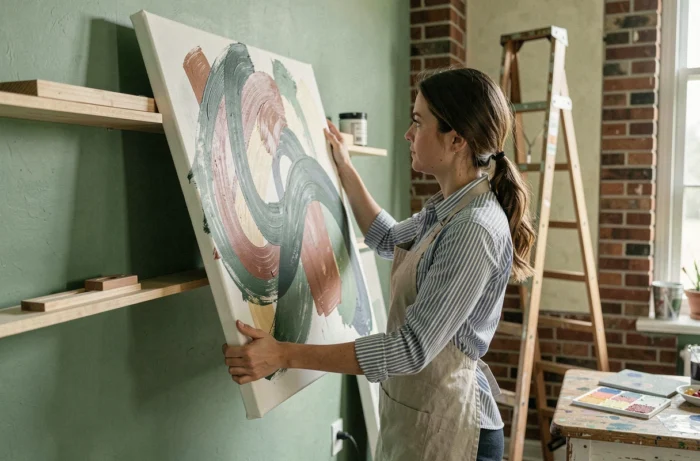
Panoramic Wallpaper and Wall Canvas: Choosing According to the Support
A panoramic wallpaper applied to a BA13 plaster wall behaves very differently than on a cement render. The porosity of the support determines the type of adhesive and the longevity of the covering. On plasterboard, a specific bonding primer prevents premature peeling and facilitates future removal without tearing the facing.
For a stretched canvas or wall fabric, the weight of the textile determines its durability over time. A weight that is too light will buckle at the slightest humidity variation. We prefer sufficiently dense canvases, either mounted on a frame or glued with a reversible adhesive.
Quick Comparison: Non-Woven, Expanded Vinyl, Textile Canvas
| Type | Ideal Support | Moisture Resistance | Ease of Installation |
|---|---|---|---|
| Non-Woven | Plaster, BA13 | Medium | High (wall gluing) |
| Expanded Vinyl | All smooth supports | Good | Medium (strip gluing) |
| Textile Canvas | Frame or smooth wall | Low | Technical |
Expanded vinyl is suitable for humid rooms like the bathroom, while non-woven remains the most versatile choice for a living room or hallway.
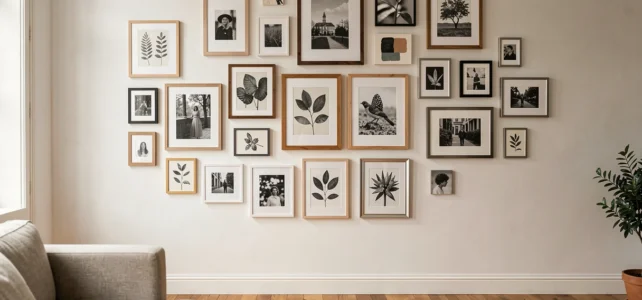
Frame and Photo Accumulation: Composition Rules That Work
A successful frame wall relies on an invisible axis of symmetry. Start by placing the largest frame at the center of the composition, then build around it while maintaining a regular spacing of five to eight centimeters depending on the size of the framed pieces.
Mixing formats (photo, illustration, mirror) adds rhythm, provided a common thread is maintained. This thread can be a limited color palette for the frames or a common theme among the visuals.
- Outline the complete arrangement on the floor before drilling, using kraft paper cut to the dimensions of each frame
- Prefer fixings suited to the actual weight of the frame: expansion plugs for hollow walls, wood screws for solid walls
- Align the visual center of the composition at eye level (about 160 cm from the floor), not the top edge of the highest frame
- Combine frames of different depths to create a slight relief that captures natural light
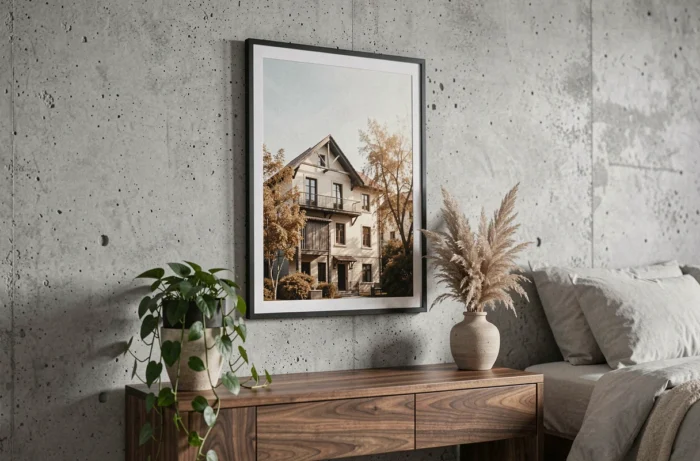
Wood, Plants, and Raw Materials: Integrating Texture Without Overloading the Space
Vertical wooden slats on a wall add depth to a room without taking up floor space. The type of wood influences both the appearance and durability: raw oak ages beautifully, while pine requires treatment to prevent yellowing.
For indoor plant walls, the main technical question remains irrigation and residual moisture on the load-bearing wall. A horticultural felt system with a recovery tray protects the support. Stabilized plants, which require neither water nor light, provide a risk-free alternative for plaster walls.
Combining Wood and Paint: Common Mistakes
Installing slats on a wall painted in a dark color creates a strong contrast, but the expansion of the wood can reveal light lines between the slats if the background shade is too saturated. We recommend painting the wall in a tone close to the chosen wood type and then focusing on texture rather than color contrast.
Another common pitfall: fixing heavy decorative elements (solid wood shelves, XXL mirrors) on drywall without reinforcement. Beyond a few kilograms, fixing into the metal stud of the framework is necessary to prevent tearing.
The style of a wall is built with as much technical rigor as decorative intent. Checking the emissions label of a paint, adapting the adhesive to the support, sizing the fixings to the actual weight of the objects: these details separate a durable wall decoration from a result that deteriorates within months.