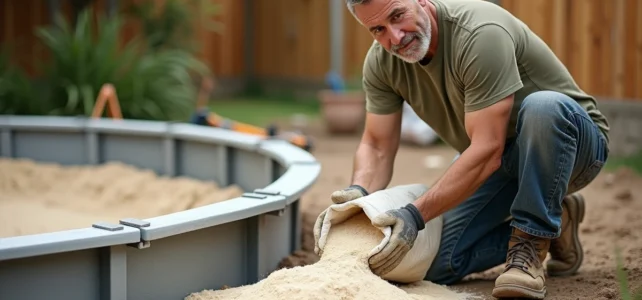
The sand under an above-ground pool serves a specific purpose: to level the ground and cushion the pressure exerted by the water on the bottom of the pool. Not all sands are suitable for this use, and choosing the wrong type can lead to deformations, punctures in the liner, or sinking of the structure’s feet. Comparing the characteristics of each available sand helps to understand which one is suitable for a given installation.
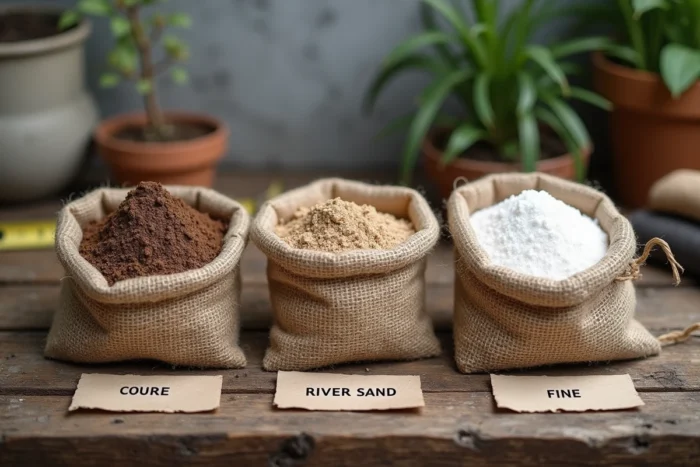
Quarry Sand, River Sand, and Stabilized Sand: Compared Properties
| Type of Sand | Grain Size | Compaction | Drainage | Recommended Use |
|---|---|---|---|---|
| Quarry Sand (0/4 crushed) | Fine to medium, angular grains | Very good (grains interlock) | Medium | Base layer for tubular and self-supporting pools |
| River Sand (alluvial) | Medium, round and smooth grains | Low (grains roll against each other) | Good | Finishing layer on already stable ground |
| Stabilized Sand (sand + cement) | Variable depending on the mix | Excellent after drying | Low | Heavy pools or semi-permanent installations |
The difference lies in the shape of the grains. The angular grains of quarry sand cling to each other once compacted, creating a dense surface that is resistant to pressure. River sand, with its round grains polished by water, behaves like a pile of marbles: it shifts under load and loses its flatness over the weeks.
Stabilized sand (a mixture of sand and a small proportion of cement) offers the best rigidity. Once moistened and hardened, it forms an almost monolithic layer. Its downside: it is not easily removed if the pool needs to be relocated.
To delve deeper into the question of what sand to put under a pool on MetamorpHouse, the criteria of grain size and compaction remain the two parameters to examine as a priority.
Grain Size and Thickness of the Sand Bed: The Technical Parameters That Matter
The ideal grain size for a base layer is in the 0/4 category (grains from 0 to 4 mm). Sand that is too fine (like beach sand) turns to mud at the first storm. Sand that is too coarse leaves roughness that marks the liner from below.
Thickness to Aim for Depending on Soil Type
- On already flat and firm ground (compacted earth, old stabilized fill): a layer of a few centimeters is sufficient to smooth out the last irregularities and protect the liner.
- On loose or slightly uneven ground: a thicker layer is necessary to absorb dips and provide proper leveling after compaction with a straightedge.
- On sloped ground: sand alone does not compensate for a marked slope. It is necessary to excavate first to obtain a level surface, then lay the sand bed as a finishing layer.
Sand does not correct a ground defect; it only smooths an already prepared surface. Attempting to compensate for several centimeters of slope with sand creates a weak point: the thick layer settles unevenly under the weight of the water.
Sands to Avoid Under an Above-Ground Pool
Some sands sold in DIY stores are not suitable for this use at all.
- Beach sand or unwashed fine sand contains salt, shells, and organic matter. Under a liner, it promotes the growth of mold and emits odors in a humid environment.
- Fill sand or all-purpose sand contains stones, pieces of clay, and plant debris. These foreign bodies create pressure points that puncture the liner under the weight of the water.
- Polymeric sand (used for paving jointing) hardens upon contact with water and forms a rigid, cracked crust, unsuitable for the flexibility required under a pool.
Washed and graded sand remains the only reliable option to protect the bottom of the pool. The additional cost compared to all-purpose sand is modest compared to the price of a replacement liner.
Large Volume Tubular Pools: Is Sand Still Enough?
The manuals from major brands of tubular pools are tightening their recommendations. For large pools (like 7 m x 3 m), a concrete slab of about 15 cm tends to replace the sand bed in manufacturer recommendations. The reason is mechanical: the metal feet concentrate the load on specific points, and the sand digs under this point pressure.
For small self-supporting or modest diameter tubular pools, compacted quarry sand remains quite suitable. The load per square meter is lower, and the pressure distribution is more even due to the absence of load-bearing feet.
Manufacturer Warranty and Type of Support
Some manufacturer warranties exclude damages occurring on a pool placed on a support not compliant with the manual. Checking the manual before choosing between sand and concrete slab helps avoid losing the warranty for a claim related to ground subsidence.
Implementation of the Sand Bed: Costly Mistakes
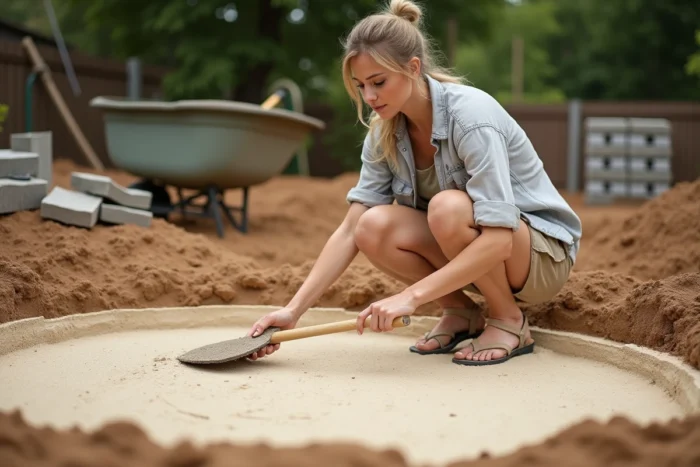
The installation itself determines the longevity of the setup. Spreading sand without compaction is like placing the pool on an unstable cushion. Compaction is done with a mason’s straightedge and roller (or vibrating plate for large areas), in successive layers that are moistened.
Each layer must be moistened and then compacted before adding the next one. Pouring the entire thickness at once and compacting the surface leaves the core of the layer loose, which causes delayed settling once the pool is filled.
A geotextile placed between the natural ground and the sand prevents the rise of roots and stones. A second geotextile between the sand and the liner adds extra protection against punctures.
The choice of sand under a pool boils down to two criteria: angular grains (quarry, not river) and washed 0/4 grain size. For large tubular pools, the concrete slab becomes the reference support for most manufacturers, and sand only plays a role as a leveling layer under this slab.