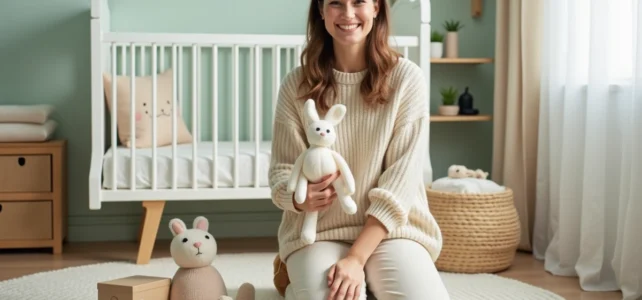
The market for baby and young children’s gifts has significantly segmented in recent years. From wooden sensory toys to personalized name accessories and connected objects for childcare, the options are plentiful. However, this abundance makes choosing more complex, especially when looking for a newborn gift that won’t end up at the back of a closet after three weeks.
Wooden Toys for Babies: Why the Market is Booming
The wooden toy segment is experiencing growth that few other categories of children’s gifts can claim. According to Fortune Business Insights, the global wooden toy market is expected to reach 30.29 billion USD by 2026, with an upward trajectory projected until 2034.
This trend is not just a passing fad. Young parents are seeking non-toxic, durable, and recyclable materials. A beech wood play gym or a lime wood puzzle meets all three criteria simultaneously, whereas a plastic toy raises concerns about phthalates or end-of-life recycling.
The premium positioning of these items also makes them perceived as more valuable newborn gifts. A handcrafted wooden rattle, engraved with the child’s name, has a different impact than a mass-produced toy in blister packaging. Specialized shops like bebes-lutins.fr offer these unique accessories designed to last beyond the first few months.
Wooden mobiles, maple teething rings, and stacking games are among the most sought-after categories. Their additional advantage: they age well visually, which appeals to parents attentive to the decor of the nursery.
Personalized Accessories for Babies: Between Embroidered Names and Durable Objects
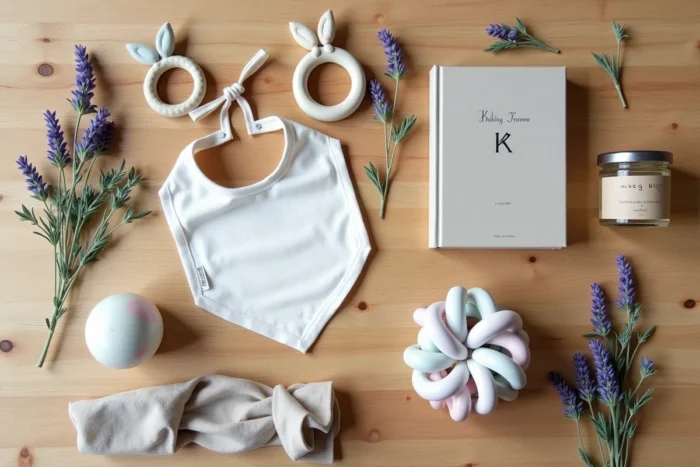
Personalization with a name remains the most commonly used lever to transform a mundane accessory into an original gift. Blankets, comforters, bibs, engraved night lights: the list grows longer each season.
What distinguishes a successful personalized gift from a quickly forgotten gadget often comes down to a simple criterion: the personalized item must remain useful even without the engraving. A quality sleeping bag embroidered with the name will be used for months. A miniature keychain with the baby’s initials will entertain for five minutes.
Criteria for a Lasting Personalized Gift
- The item must have a clear daily function (sleep, meals, transport, play) so it doesn’t become a quickly stored decorative object
- The personalization technique matters: embroidery withstands repeated washing better than heat transfer printing, which peels off after a few washes
- Check the textile composition before gifting, especially for items in direct contact with the baby’s skin (certified organic cotton, formaldehyde-free dyes)
Gift sets combining a customizable comforter and a wooden sensory accessory represent a well-appreciated compromise. They blend the emotion of the embroidered name with the durability of natural materials.
R129 i-Size Standard: What It Changes for Transport-Related Gifts
Giving a travel accessory for babies (car seat reducer, support cushion, monitoring mirror) requires particular vigilance since the strengthening of the R129 standard, known as i-Size. This European regulation, stricter than the previous R44, now requires that restraint systems be adapted to the child’s height rather than their weight.
In practice, this means that a gift like a reducer or seat belt cover must be compatible with the i-Size car seat used by the parents. An accessory designed for the old standard can create a false sense of security or even hinder the harness’s function.
Transport Accessories to Prefer or Avoid
- Back seat organizers, sunshades, and monitoring mirrors remain safe bets: they do not interfere with the restraint system
- Cervical support cushions and seat belt covers should be checked for i-Size compatibility before purchase
- Non-certified car seat reducers from the seat manufacturer should be avoided, even if marketed as “universal”
A transport accessory not compatible with the i-Size standard can compromise safety, making it a risky gift if the exact equipment of the parents is unknown.
Sensory Play Gifts: Focusing on Quality Rather Than Quantity
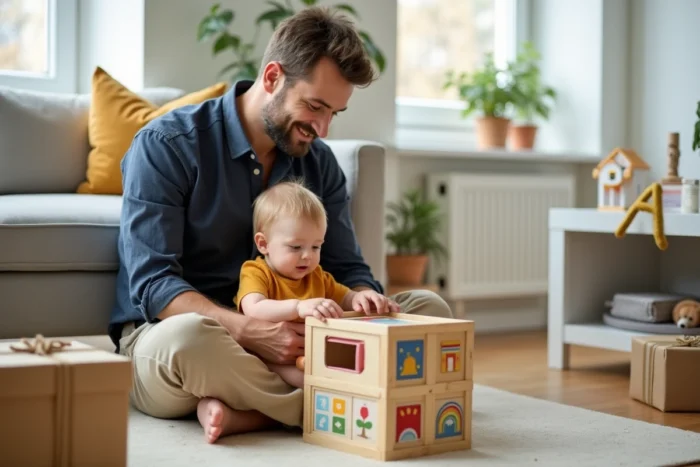
Sensory toys represent the most commonly given category for babies aged zero to twelve months. The classic pitfall is to multiply small objects (rattles, stuffed animals, rings) without coherence, which saturates the play space and scatters the child’s attention.
A sensory play gift benefits from targeting one channel at a time. A play mat with varied textures engages touch. A mechanical music box made of wood stimulates hearing without screens or batteries. One well-chosen sensory object stimulates more than a dozen accumulated gadgets.
Night lights are among the most popular accessories. Models with adjustable intensity and warm light serve both as a nighttime marker for the baby and as additional lighting for parents during nighttime feedings or changes. Some night lights include a white noise feature, which appeals to families facing sleep difficulties.
Stuffed Animals and Comforters: The Detail That Changes Everything
The stuffed animal remains the quintessential newborn gift, but feedback from the field varies on the actual utility of large stuffed animals. Pediatric recommendations discourage bulky objects in the infant’s crib. A flat, lightweight, machine-washable comforter at sixty degrees will be adopted more easily than a large stuffed animal relegated to a shelf.
Ultimately, the choice of a gift for a baby rests on a balance between immediate emotion and medium-term use. The items that withstand the seasons, washes, and stages of development are those that parents most often mention when asked which newborn gift truly made an impression.