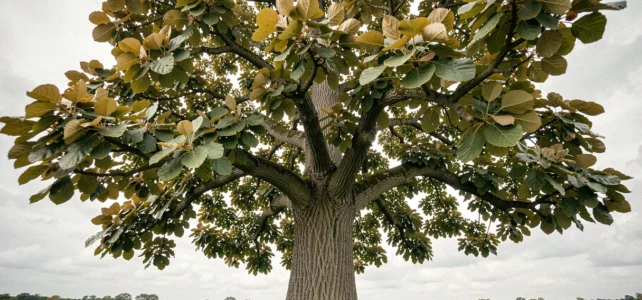
When planting a catalpa in a garden, one expects quick shade and generous blooming. What one discovers upon digging into the subject is that this tree carries with it several centuries of stories, forgotten uses, and cultural meanings that far exceed mere ornamental purposes. The catalpa tree is striking both for its imposing silhouette and for what it has represented for the peoples who first encountered it.
Catalpa and Volatile Compound Emissions: An Overlooked Angle in Planting Guides
In urban greening programs, the catalpa regularly appears in nursery catalogs as a resilient tree, tolerant of heat and drought. It is recommended for creating shade in schoolyards, parking lots, and public squares.
This positioning as a climate tree masks a rarely discussed aspect. Recent work in urban ecology warns that selecting trees solely based on thermal resilience can increase emissions of volatile organic compounds (VOCs), which promote the formation of ground-level tropospheric ozone. The catalpa, native to warm and humid environments, falls into this category of species whose behavior in urban settings remains little evaluated from this perspective.
In practical terms, this means that planting a catalpa to cool a space can produce an undesirable effect on air quality if planting density and local context are not taken into account. Here we find a paradox documented for other species: the tree that provides shade can also contribute to a photochemical pollution problem.
When one is interested in the symbolism of the catalpa tree, it becomes clear that its place in our landscapes is not solely based on aesthetic or climatic considerations, but also on a rich cultural heritage that deserves exploration.
Heart-Shaped Leaves and Hanging Pods: What the Catalpa Tells About Itself
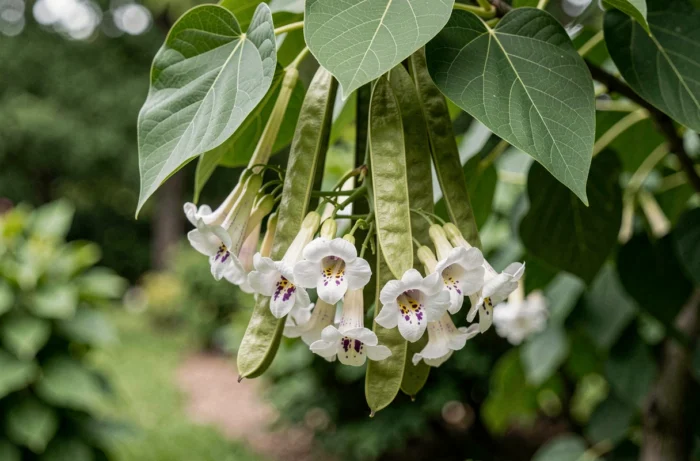
The catalpa bignonioides, the most widespread species in France, is recognized by its large heart-shaped leaves that can exceed the size of an open hand. This massive foliage gives it a rounded, almost parasol-like shape, casting a dense shadow on the ground.
Its white flowers, speckled with purple, appear in upright panicles at the end of spring. They resemble those of orchids due to their asymmetrical shape. The long, slender pods that follow the blooming have earned it the nickname “cigar tree,” a vernacular name found both in France and North America in the form “Indian bean tree.”
Field Recognition
To avoid confusing the catalpa with the paulownia (a common mistake), three things should be checked:
- The leaves of the catalpa are opposite or whorled in threes, never alternate like those of the paulownia
- The flowering of the catalpa occurs after the leaves emerge, while the paulownia blooms on bare wood, before the foliage
- The pods of the catalpa are cylindrical and persist for part of the winter, whereas the paulownia produces round capsules
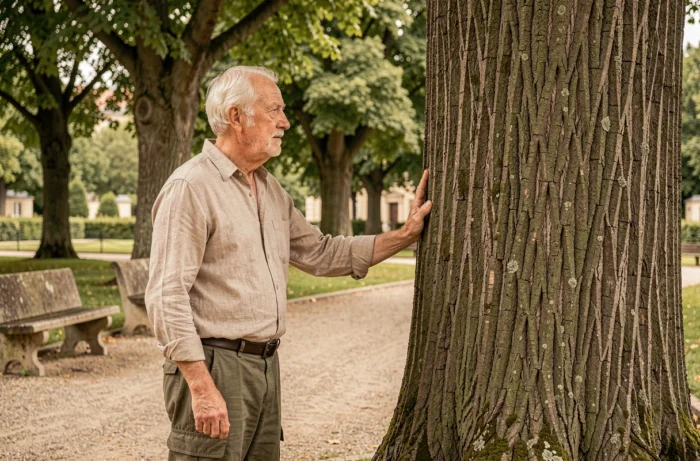
This distinction is important when trying to identify an old specimen in a park or urban alignment. Centennial catalpas easily reach ten meters in height with a short, twisted trunk that gives them a sculptural appearance.
Catalpa Among Indigenous Peoples of America: A Tree with Practical Uses
The word “catalpa” comes directly from the language of the Muscogees (Creek), an indigenous people of the southeastern United States. The English naturalist Mark Catesby documented the term in his work on Florida in the first half of the 18th century, and it is through English that the word entered the French botanical vocabulary.
The catalpa was not an ornamental tree for the peoples who lived alongside it. Its rot-resistant wood was used to make fence posts and stakes. This property of natural durability was later exploited for the production of railroad ties in certain regions of the United States.
The bark and pods were used in traditional pharmacopoeia preparations. Reports vary on this point according to ethnobotanical sources, but several texts mention a use against respiratory ailments and intestinal parasites.
Planting a Catalpa in French Soil: Constraints and Suitable Terrain
The catalpa thrives in a deep, cool, and well-drained soil. It tolerates calcareous soils and can withstand moderate drought periods once well established. Planting is ideally done from October to March, avoiding frost.
In France, it can be found in most regions, including in continental climates. Its hardiness easily descends below minus fifteen degrees. The main limiting factor is not the cold but the wind: its large leaves offer significant resistance, and young specimens can suffer in exposed sites.
Pruning and Leaf Management
Pruning the catalpa is done at the end of winter. It can be trained as a multi-stem (multiple trunks from the base) or as a single stem. Pollarding remains the most common method in urban settings, as it limits clutter while maintaining vigorous leaf renewal each year.
One point to anticipate: leaf drop in autumn is massive. The large leaves decompose slowly and can clog gutters or cover a lawn in just a few days. In a small garden, this additional maintenance should be weighed before planting.
- Exposure: full sun to partial shade, sheltered from prevailing winds
- Watering: regular for the first two years, then spaced out
- Spacing: allow at least six to eight meters between two specimens to let the natural shape develop
- Roots: shallow, spreading root system, to be kept away from foundations and pipelines
The catalpa remains a tree of significant size. In a modest-sized garden, the dwarf variety Catalpa bignonioides ‘Nana’ offers a compact ball shape, although it blooms much less than the typical species. For larger spaces, the taller Catalpa speciosa presents an interesting alternative with comparable blooming and a more upright form.
Whether chosen for its shade, spectacular flowers, or the curiosity of its long hanging pods, the catalpa makes its presence felt. Its history spans continents and centuries, from the forests of the southeastern United States to French municipal parks, never losing that unique blend of robustness and elegance.