
A running legging that itches after twenty minutes, a pair of fitness shoes too rigid for your lateral support, a fabric that deforms after the third wash: sports equipment directly affects the quality of your sessions. Choosing the right gear involves considering three often-overlooked parameters: the biomechanics of your practice, the actual durability of the product, and the standards that now govern its manufacturing.
Repairability and circular design: the criteria that labels do not show
Have you ever thrown away a pair of sneakers because an inner seam had come undone, even though the sole was still intact? This scenario illustrates a design problem, not normal wear and tear. New European guidelines on sustainability are pushing manufacturers to integrate principles of circular design in sports equipment. Specifically, this means soles that can be re-glued, fabrics whose recycled fibers retain their mechanical properties, and replaceable parts (laces, inner foams, reinforcements).
Before buying, check if the brand offers a repair service or spare parts. Repairable equipment may sometimes cost a bit more upfront, but its cost per session decreases significantly over time. Recycled materials are also improving in quality: recycled polyester fibers now reach resistance levels comparable to virgin fibers, which addresses the classic objection regarding performance loss.
On azsport.ch, product sheets allow you to compare technical specifications and identify equipment whose composition promotes longevity.
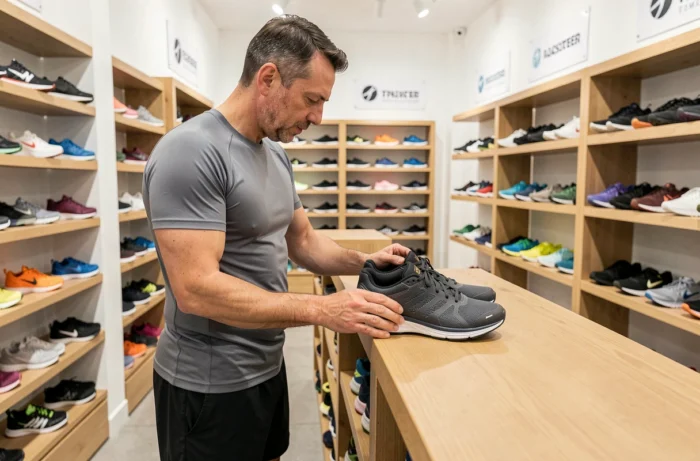
Shoes, clothing, accessories: technical criteria by equipment category
Grouping all equipment under the same framework leads to poor choices. Each category responds to different constraints.
Sports shoes: cushioning, support, and type of stride
The choice of a shoe primarily depends on your stride (pronated, supinated, or neutral). Too soft cushioning for a heavy runner accelerates joint fatigue. Conversely, a very rigid shoe is suitable for sprinting but not for gym workouts, where multidirectional support requires flexibility.
- Running: prioritize cushioning suitable for your weight and training frequency, with a drop that corresponds to your foot placement technique
- Weight training and fitness: opt for a flat and stable sole that promotes grounding during load exercises
- Team sports: look for enhanced lateral support and a sole with grip suited to the playing surface (indoor, synthetic grass, clay)
Sports clothing and gear: beyond immediate comfort
A comfortable fabric is not enough. The performance of sportswear relies on its ability to wick away sweat without soaking up water, to minimize friction on sensitive areas, and to maintain its elasticity after dozens of washes.
Check the composition. A polyester-elastane blend generally offers a good compromise between breathability and support. Cotton, despite its pleasant touch, absorbs moisture and weighs down the outfit during exertion. For recovery, some compression garments apply graduated pressure that promotes venous return, which is particularly useful after intense weight training sessions.
Connected equipment and performance accessories: distinguishing gadgets from useful tools
Sensors, watches, and connected accessories represent the fastest-growing segment in the sports equipment market. Bluetooth connectivity and embedded artificial intelligence now allow for personalized tracking of heart rate, stride quality, or number of repetitions in weight training.
However, not all these accessories are equal. A useful sensor answers a specific question about your training. If you are looking to improve your endurance, a reliable heart rate monitor is more beneficial than a multifunction bracelet whose data you will never fully utilize.
Ask yourself before purchasing: what indicator will I actually check after each session? If the answer is vague, the accessory will end up in a drawer. Simple accessories (resistance bands, massage rollers, jump ropes) often remain the most cost-effective in terms of progress because they are consistently used.
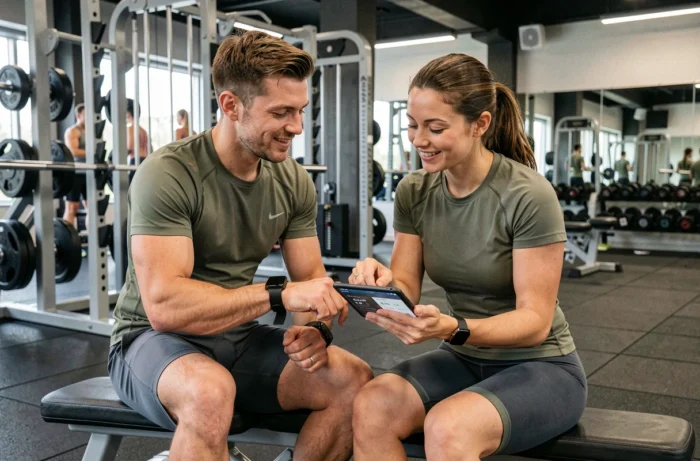
Durability and European standards: what is changing for sports equipment
The European regulatory pressure on durability and product safety does not only concern toys or electronics. Sports equipment is gradually being affected by requirements for transparency regarding material composition, fiber traceability, and the actual resistance of the product to repeated use.
For consumers, this translates into more comprehensive information on labels and online product sheets. Check for mentions related to European compliance and safety certifications, especially for protective equipment (helmets, shin guards, knee pads). A product that complies with current standards has undergone tests for impact resistance, abrasion, and deformation.
A compliant and repairable piece of equipment protects better than a low-quality product replaced every season. The initial investment is justified by safety and consistent performance over time.
The market is increasingly leaning towards accessories with a short replacement cycle (gloves, technical socks, resistance bands). For these small items, the logic remains the same: check the composition, compare user feedback on durability, and favor brands that clearly display their commitments to responsible manufacturing.
Choosing suitable sports equipment means taking a few minutes to consider technical details rather than relying solely on design or price. The next time you hesitate between two products, look at the sole, read the fabric composition, and check if spare parts are available. This simple reflex changes the lifespan of your gear, and often the quality of your sessions.