
The envelope format, the paper weight, the typographic layout of the sender and recipient areas: these technical details affect the readability of a spontaneous job application before the recruiter even opens the envelope. We notice that most guides focus on the content of the letter and neglect the physical object that carries it.
Paper Weight and Envelope Format for a Spontaneous Application
An envelope that is too thin crumples the documents, while an envelope that is too thick gets stuck in the mail sorting bins. A sufficiently dense weight prevents transparency and creasing. We recommend a matte coated or laid paper between standard and heavy, which protects the CV without excessively stiffening the envelope.
The C4 format (229 x 324 mm) remains the only rational choice for a spontaneous application. It allows for inserting A4 documents flat, without folding. A CV folded in three inside a DL envelope betrays a careless submission, especially if the CV paper is thick and retains the crease mark.
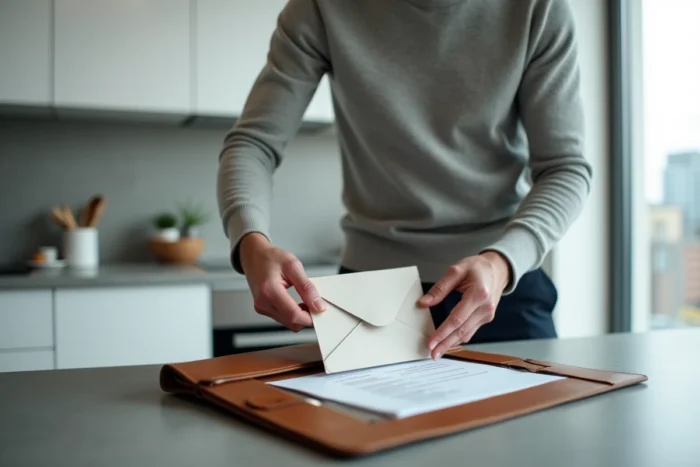
Knowing how to present an envelope for a spontaneous application also involves choosing between a gusseted folder and a flat folder. The gusseted folder is suitable when the application exceeds four or five sheets (CV, letter, portfolio, certificates). Beyond that, a protective A4 cardboard slipped behind the documents prevents any deformation during postal transport.
Typographic Layout: Sender and Recipient Areas According to Postal Standards
The AFNOR NF Z 10-011 standard defines the addressing zones on an envelope. The recipient area occupies the lower right third of the front side. It must contain a maximum of six lines, aligned to the left, without punctuation at the end of the line.
The last line (postal code and city) is written in uppercase without accents. This technical constraint facilitates optical reading by sorting machines and reduces the risk of delays or returns.
Sender Area and Job Title Mention
The sender area is placed at the top left of the front or on the back flap. We observe a common mistake: writing only one’s name without mentioning their job title or area of expertise. In a spontaneous application, the recruiter is not expecting you. Adding a line under your name (for example, “Industrial Methods Technician” or “Digital Communication Officer”) creates an initial signal of relevance.
APEC also recommends not writing “Spontaneous Application” as a generic subject but opting for a solution-oriented formulation, such as “Service Offer” followed by your profession. This logic also applies to the envelope: the handwritten note at the bottom left of the front (area reserved for service indications) should be specific rather than vague.
Handwriting or Printing: Decide Based on the Sector
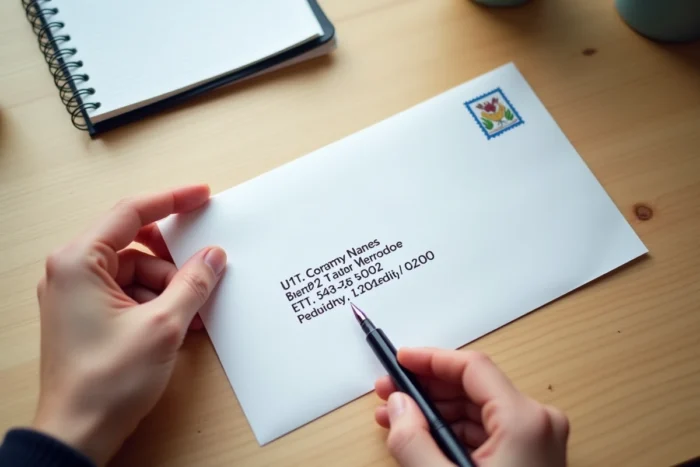
The recipient’s address printed on a white adhesive label remains the most readable standard. However, a carefully handwritten address can differentiate a letter in a flow of printed mail, provided that the handwriting is consistent and without corrections.
We recommend laser printing for structured sectors (banking, industry, administration) and handwriting in black or dark blue ink for sectors where personal contact is prioritized (crafts, SMEs, local businesses). A fine ballpoint pen produces a clean line on coated paper, while a felt tip smudges and a rollerball catches.
Stamp Positioning and Additional Mentions
A postage at the priority letter rate signals to the recipient that the mailing is well-prepared. The stamp is placed in the upper right corner, at least five millimeters from the edge, to avoid partial cancellation by the machine.
The mention “Personal and Confidential” at the bottom left of the front can direct the mail straight to the named recipient, bypassing the general mail service. This is an underutilized lever in large organizations where internal sorting dilutes spontaneous applications.
Targeting and Personalization: What Happens Before Stamping the Envelope
APEC advises to limit spontaneous prospecting to a maximum of five companies and to study them thoroughly before sending. This strict targeting principle changes the game: instead of preparing twenty identical envelopes, you invest time in five impeccable ones.
Specifically, this preparation involves checking three points before writing the address:
- The exact name of the recruitment manager or department head, verified on the corporate site or LinkedIn, to address the envelope personally.
- The updated postal address of the site where the targeted position is located, not that of the headquarters if the company has multiple locations.
- The existence of a real need, identified through recent job postings, announced projects, or visible personnel movements online.
Several recent sources also recommend attaching a first concrete proof of competence to the application: a short deliverable, a link to a documented project, or a mission certificate. This additional piece enhances the credibility of the approach and justifies the flat C4 format.
Technical Errors That Undermine a Job Application Envelope
Some errors go unnoticed by the sender but are immediately spotted by the recipient:
- Excess tape on the flap, which gives the impression of a resealed package and complicates opening.
- A window envelope used without alignment: the letter slips during transport and the address disappears behind the frame.
- Documents inserted loosely without a cardboard folder or paperclip, forcing the recruiter to reconstruct the order of the application.
The envelope is the first physical object that the recruiter handles. A clean envelope, properly stamped, addressed personally with a job title mention, positions the application as a structured professional approach. The care taken with this support says something about the candidate’s rigor, well before the CV is read.