
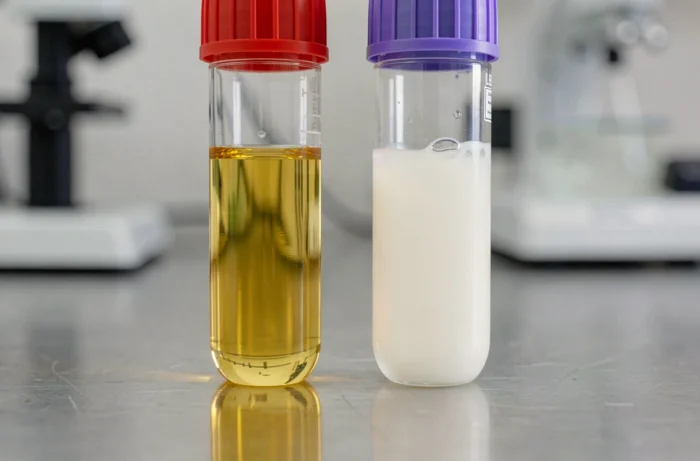
An opalescent serum on a lipid panel results sheet indicates an excess of circulating lipids, primarily triglycerides. This milky or cloudy appearance, far from being a mere aesthetic detail of the sample, directly guides the course of action: check fasting conditions, quantify triglycerides, and assess the risk of serious complications such as acute pancreatitis.
Analytical Interferences of Opalescent Serum on Lipid Measurement
The visible lipemia in a blood tube presents a concrete technical problem even before any clinical interpretation. A serum loaded with lipid particles scatters light, which disrupts the spectrophotometric methods used by laboratory automates.
The assays most affected are not always those one might expect. Total cholesterol and HDL cholesterol experience variable biases depending on the technique used, while the triglycerides themselves may be underestimated when turbidity is very high. Other non-lipid parameters (bilirubin, creatinine, liver enzymes) are also distorted by this optical interference.
The appearance of the opalescent serum in lipid panel thus represents a warning signal for the biologist, who must adapt their analysis method or report the interference in the results. Some laboratories perform ultracentrifugation or dilution to correct the bias, but these techniques are not always available.
| Serum Appearance | Meaning | Impact on Measurements |
|---|---|---|
| Clear (light yellow) | Lipid profile within normal values | No analytical interference |
| Cloudy | Moderate excess of triglycerides | Possible bias on HDL and bilirubin |
| Opalescent / milky | Marked hypertriglyceridemia | Falsely lowered on several parameters, LDL not calculable if triglycerides are too high |
| Hemolyzed (red) | Destruction of red blood cells (difficult sample) | Interference on potassium, muscle enzymes |
| Icteric (dark yellow) | Excess bilirubin | Bias on creatinine, cholesterol depending on the method |

High Triglycerides and Milky Serum: Pancreatic Risk Thresholds
The central question when faced with an opalescent serum is the actual level of triglycerides. A serum that is simply cloudy may correspond to a fasting oversight or moderate hypertriglyceridemia. A distinctly milky serum points to significantly more concerning values.
At 500 mg/dL of triglycerides, the risk of acute pancreatitis becomes the clinical priority, according to recent management recommendations for hypertriglyceridemia. Cohort data indicate a threefold increase in the risk of pancreatitis at this threshold, with a very steep rise beyond 1,000 mg/dL.
The Friedewald formula, routinely used to calculate LDL cholesterol, becomes inapplicable when triglycerides exceed 4 g/L (approximately 4.6 mmol/L). The report then states “LDL not calculable,” which does not mean that LDL is normal, but that the laboratory cannot quantify it using this method.
Two Distinct Situations Not to Be Confused
An opalescent serum in a patient who has not fasted for at least twelve hours necessitates a repeat sample under the required conditions. Postprandial hypertriglyceridemia typically resolves within a few hours.
In contrast, an opalescent serum despite proper fasting indicates a lipid metabolism anomaly that requires medical evaluation. Possible causes include:
- Primary hypertriglyceridemia (genetic), such as familial chylomicronemia, where triglycerides can far exceed 1,000 mg/dL
- Secondary hypertriglyceridemia related to uncontrolled diabetes, hypothyroidism, renal failure, excessive alcohol consumption, or certain medications (corticosteroids, isotretinoin, beta-blockers)
- A combination of both, common in practice: a genetic background unmasked by an aggravating factor
Concrete Actions to Take After an Opalescent Serum Result
The prescribing physician receives the result with a note on the serum appearance. The next steps depend on the clinical context and the measured triglyceride level.
Verification of Sample Collection Conditions
The first step is to ask the patient about adherence to fasting. A high-fat meal consumed the night before may be enough to render the serum opalescent the following morning. If fasting was not respected, a new sample after twelve hours of strict fasting is the priority before any further exploration.
Search for a Secondary Cause
When fasting was properly observed, the assessment broadens. A fasting blood glucose test, TSH (thyroid) measurement, renal function evaluation, and inquiry about alcohol consumption and ongoing treatments help identify a treatable cause.
Correcting the secondary cause lowers triglycerides in the majority of cases, sometimes dramatically: balancing diabetes or treating hypothyroidism can normalize an initially milky serum.
Dietary Measures and Pharmacological Treatment
Recent recommendations place hygienic-dietary measures at the forefront:
- Drastic reduction of fast sugars and alcohol, which stimulate hepatic triglyceride production
- Increased regular physical activity, even moderate, which improves the metabolism of triglyceride-rich lipoproteins
- Weight loss if necessary, with a proportional effect on lowering triglycerides
- Introduction of fibrates or high-dose omega-3s when triglycerides remain above 500 mg/dL despite dietary measures, to prevent pancreatitis
Non-calculable LDL Cholesterol and Cardiovascular Risk: A Blind Spot in the Assessment
When the serum is opalescent, calculating LDL cholesterol using the Friedewald formula is often impossible. The missing result creates a blind spot in the assessment of cardiovascular risk, as it is precisely LDL that guides therapeutic decisions (statins, target goals).
Direct LDL measurement methods exist and can be requested as a second-line option. Measuring apolipoprotein B provides a useful alternative: each atherogenic particle carries one apoB molecule, making it a reliable marker of the total number of at-risk particles, regardless of triglyceride levels.
An opalescent serum should therefore not overshadow cardiovascular risk in favor of solely pancreatic risk. Both management axes coexist, and the physician adapts the strategy based on the patient’s overall profile: family history, diabetes, hypertension, smoking.
The result “opalescent serum” on a lipid panel is not a laboratory anomaly to be ignored. It is an immediate visual signal that points to potentially serious hypertriglyceridemia, where verifying fasting, searching for a secondary cause, and assessing the pancreatic threshold determine the subsequent management.