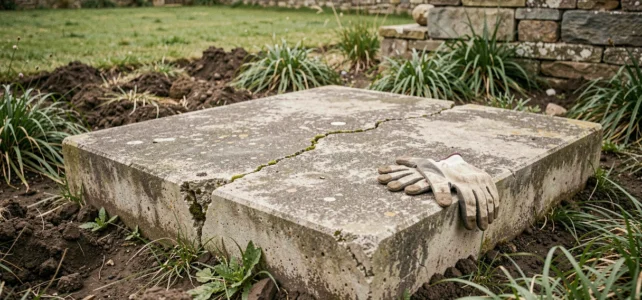
An old concrete septic tank only treats sewage, meaning the water from toilets. This limitation, which distinguishes it from a all-water tank, conditions its entire hydraulic scheme. Understanding the flow of effluents in this type of tank allows for the assessment of what still works, what malfunctions, and what the SPANC checks during an inspection.
Hydraulic circulation in a single-compartment concrete tank
Most old concrete septic tanks adopt a single-tank scheme, sometimes partitioned by a perforated internal wall. The effluent enters through a pipe located in the upper third of the tank, on the house side. An inlet tee (or a molded concrete deflector) directs the flow downward to avoid disturbing the floating layer on the surface.
Inside, two zones coexist vertically. The lower part accumulates sludge through sedimentation. The upper part retains a layer of fats and light materials. Between the two, a so-called “clarified” zone allows the partially treated water to reach the outlet through a second tee, also oriented downward to avoid sucking in the floatables.
This mechanism relies on anaerobic fermentation without oxygen supply, ensured by bacteria that slowly degrade organic matter. The process generates H2S gas (hydrogen sulfide), which explains the mandatory presence of a high ventilation. In older installations, this ventilation often consists of a simple roof vent, sometimes blocked after decades without maintenance.
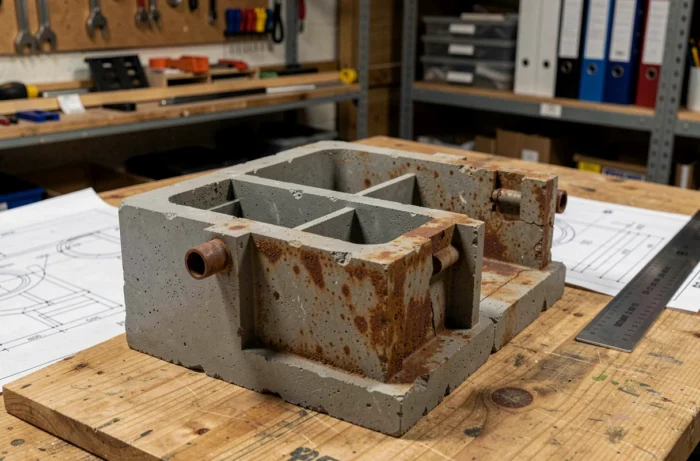
To visualize precisely the arrangement of each element (tees, partitions, pipes), a diagram of an old concrete septic tank details the locations and characteristic dimensions of models installed before the year 2000.
Old septic tank vs. all-water tank: table of technical differences
Confusion between these two sanitation systems remains common. The terms are used interchangeably, while their treatment scope differs radically.
| Criterion | Old septic tank (concrete) | All-water tank (post-2009 standard) |
|---|---|---|
| Treated water | Sewage only (toilets) | Sewage + household water (kitchen, bathroom, washing machine) |
| Ventilation | Simple vent, often undersized | Primary ventilation + mandatory high extraction |
| Pre-filter | Absent on most models | Integrated or at the tank outlet |
| Grease trap | Sometimes added separately for the kitchen | Not required if the all-water tank is properly sized |
| Secondary treatment | Rudimentary spreading or direct discharge | Sized spreading, sand filter, or micro-station |
The most consequential difference concerns secondary treatment. An old concrete septic tank often settled for discharging into a soakaway or ditch, without a real treatment system. The decree of September 7, 2009, prohibits the installation of tanks treating only sewage, rendering this type of device obsolete for any new construction.
SPANC Diagnosis: what makes an old tank non-compliant
A widespread belief is that an old septic tank is automatically non-compliant. The reality is more nuanced: age alone is not enough to render the installation non-compliant. SPANC evaluates the actual health and environmental risk, not just the age of the system.
During the inspection, the technician examines several specific points:
- The watertightness of the tank: cracks in the concrete, groundwater infiltration, or effluent leaks into the surrounding soil.
- The condition of the ventilation: a blocked vent causes an accumulation of H2S that accelerates concrete corrosion and degrades fermentation quality.
- The presence and proper functioning of secondary treatment downstream of the tank, which is the most frequently failing criterion in older installations.
- The sludge level: if it exceeds half the useful volume, sedimentation no longer occurs properly, and solid materials head toward the outlet.
In the case of a real estate sale, the SPANC report must be less than 3 years old at the time of signing. If the diagnosis reveals a proven risk, the buyer has one year after the purchase to carry out the necessary upgrades.
Concrete corrosion by H2S: the structural weak point
The H2S gas produced by anaerobic fermentation transforms, upon contact with the moisture of the walls, into sulfuric acid. This phenomenon progressively attacks the internal surface of the concrete, creating characteristic crumbling on the vault and walls above the water level.
On a tank installed several decades ago, this corrosion can significantly reduce the thickness of the walls. The risk is not a sudden collapse, but a gradual loss of watertightness. The effluent then infiltrates into the soil untreated, which precisely constitutes the environmental risk that SPANC seeks to identify.
Visible signs during an inspection
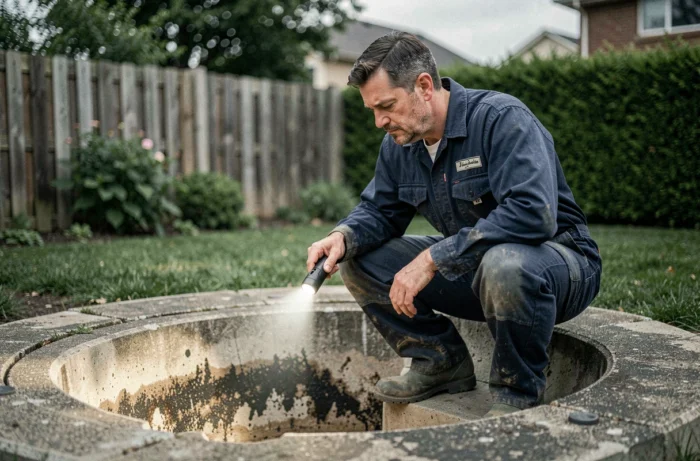
The inside of the tank shows crumbling concrete, sometimes reduced to a gritty sand-like texture to the touch. Metal reinforcements appear in places, oxidized. The vault may show whitish marks (efflorescence) or calcite stalactites, signs of water infiltration from outside through the degraded concrete.
A professional can apply a protective coating or epoxy resin to extend the life of the tank. This repair does not exempt the need to add secondary treatment if it is lacking, but it can prevent a complete replacement when the structure remains sound.
The diagram of an old concrete septic tank reveals a system designed for a single function: to decant sewage by gravity. This simplicity, which has made it robust for decades, also explains its limitations in the face of current requirements for treating domestic wastewater. Only the SPANC inspection can determine between rehabilitation and replacement, based on the actual condition of the tank and the downstream system.