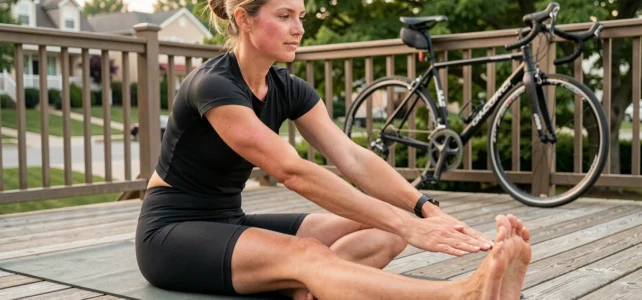
After a two-hour ride on the road or an intense session on a home trainer, you get off the bike, put away the gear, and move on to something else. The problem arises the next day or the day after: stiffness in the hamstrings, tension in the lower back, and a decline in pedaling amplitude from ride to ride.
Stretching after cycling doesn’t solve everything, but it targets a specific point that pedaling never works on: long-term joint flexibility.
What pedaling really does to your muscles
The pedaling motion is repetitive and occurs within a limited range of motion. The quadriceps, hamstrings, and calves work in cyclic contraction without ever reaching their maximum length. The result: these muscles strengthen, but they gradually shorten.
This shortening isn’t just a comfort issue. It alters your position on the bike. A tight psoas pulls the pelvis into an anterior tilt, increasing pressure on the lower back. Tight hamstrings limit hip flexion and reduce power at the top of the pedal stroke.
It becomes clearer why stretching after cycling primarily aims to restore the range of motion lost during exertion, rather than relieve immediate pain. It’s a cumulative effort: a few minutes after each session yield measurable flexibility gains over several weeks.

Post-cycling stretches and soreness: a persistent misconception
Most online guides present stretching as a remedy for the next day’s soreness. Recent scientific data tells a different story. Several systematic reviews and meta-analyses published between 2018 and 2024 converge on the same conclusion: post-exercise stretching does not significantly reduce soreness.
Delayed onset muscle soreness (known as DOMS) results from micro-tears in muscle fibers. Stretching a muscle that is already damaged does not repair these tears. The analgesic effect measured in studies is deemed not clinically relevant.
So why stretch? Because the real goal is long-term flexibility, not immediate comfort. And on this point, recent summaries are clear: regular static stretching increases joint range of motion sustainably in endurance athletes.
What stretching does not do after a cycling session
- It does not measurably reduce soreness, even when performed within an hour after exertion
- It does not replace a complete recovery strategy (hydration, nutrition, sleep)
- It does not compensate for poor saddle or cleat adjustments, which remain the primary cause of chronic pain in cyclists
Which muscles to prioritize stretching after a cycling session
You don’t need to go through a complete yoga routine. After cycling, four muscle groups deserve special attention because they are consistently engaged in a reduced range of motion.
Hamstrings and quadriceps
These two antagonist groups manage knee flexion and extension during pedaling. Stretching the hamstrings restores the natural tilt of the pelvis, which protects the lower back. For the quadriceps, a standing stretch by bringing the heel towards the buttock is sufficient, provided the knee remains aligned.
Psoas-iliacus and hip flexors
The bent position on the bike keeps the psoas in constant shortening. It is often the culprit behind lower back pain after a long ride. A low forward lunge, with the back knee on the ground, stretches this muscle deeply.
Calves and lower back
The calves absorb the push at the end of the pedal stroke. The lower back compensates for the tension accumulated by the entire posterior chain. A calf stretch against a wall, held without forcing, completes the routine in under two minutes.

Duration and intensity of stretching for cyclists: practical guidelines
The duration of holding changes everything. Static stretches that are too long (beyond one minute per muscle) performed immediately after intense exertion can lead to a slight decrease in strength and power. This isn’t an issue if you’ve finished your session, but it becomes one if you have two workouts in a day.
A practical guideline that works for most cyclists:
- Hold each position for 20 to 30 seconds, without jerks or bouncing
- Seek the sensation of stretching, never pain; the muscle should “pull” without burning
- Perform the routine within an hour after finishing the effort, when the muscles are still warm
- Repeat the sequence after every ride, not just after long sessions
Feedback varies on the usefulness of dynamic stretching post-exercise. Some cyclists prefer light ballistic movements (leg swings) before moving on to static stretches. Others go straight to static. Consistency matters more than the chosen method.
Stretching and overall recovery: what really makes a difference
Isolating stretching from the rest of recovery makes no sense in practice. A cyclist who stretches diligently but sleeps poorly and hydrates little will see no improvements in flexibility or comfort.
The sequence that produces results combines several actions in a logical order: gradual cool down on the bike, followed by light stretching, then rehydration and protein intake. Some routines add a cold bath to lower body temperature after a long effort in the heat, but this remains optional.
Stretching after cycling is not a magic wand against pain nor a shortcut to performance. Its true role is more modest and useful: to maintain a range of motion that pedaling gradually erodes ride after ride. Over several months of regular practice, this preserved flexibility translates into a more stable position, fewer compensatory movements, and a body that handles training loads better.