
A bank appointment for a student loan often falls short for a simple reason: a document is missing. The enrollment certificate is left in an unread email, the bank account details are from an old account, or the proof of residence does not match the declared address. Preparing your student loan application in advance avoids unnecessary back-and-forth and saves several weeks on the release of funds.
Bpifrance Pre-Eligibility Certificate: the document most applications forget
For a state-guaranteed student loan (PEGE), banks now require a pre-eligibility certificate issued by Bpifrance. This document, obtained online through the Bpifrance Token platform, is a condition for the acceptance of the application at several institutions. Without this certificate, the advisor cannot initiate the processing of the guaranteed loan.
This is a verification step: Bpifrance confirms that the borrower’s profile is compatible with the guarantee scheme without family collateral. The certificate is generated in a few minutes, but it requires having a valid ID and an enrollment certificate on hand. It is better to download it before making an appointment.
This point is rarely mentioned in standard guides. By consulting the required documents on Partenaire Financier, you can find the details of the documents expected by banks for each type of student loan, guaranteed or not.

Identity Documents and Proof of Residence: What Really Holds Up Applications
A valid identity card or passport is something everyone thinks of. The problem rather lies with the proof of residence. For a student living in a university residence, shared accommodation, or with a parent, the required document varies.
- In Crous or private residences: a certificate of accommodation issued by the manager, accompanied by a recent bill (electricity, internet) in the name of the residence, is sufficient in most cases.
- At a parent’s or third party’s home: a sworn certificate of accommodation signed by the host, their ID, and a proof of residence in their name dated within the last three months is required.
- In shared accommodation with an individual lease: the lease and a service bill in the applicant’s name serve as proof.
A proof of residence older than three months will be systematically refused. When moving in September for the new school year, the first bill in the new name sometimes arrives late. Anticipating by requesting a certificate from the energy provider as soon as you move in avoids this blockage.
Case of Foreign Students Residing in France
Since the summer of 2026, requirements have tightened for non-resident students. In addition to the ID, a valid student residence permit and translated civil status documents may be required. Citizens of the European Economic Area must prove continuous residence in France for at least two years to access the state-guaranteed loan.
Enrollment Certificate and Academic Documents: The Right Format at the Right Time
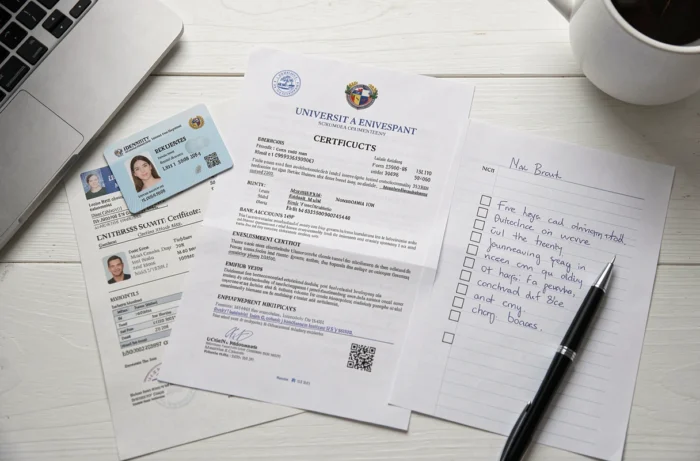
The enrollment certificate proves registration at a higher education institution in France. The bank needs it to verify that the borrower is indeed preparing for a diploma, an exam, or an eligible certification (BTS, bachelor’s, master’s, business school, engineering school).
In practice, this certificate is downloaded from the institution’s digital space. Two precautions to take: ensure that the document bears the school’s stamp or electronic signature, and confirm that it mentions the current academic year. A certificate from the previous year will not be accepted for a loan taken out for the following school year.
For a late re-registration or a change of institution, a provisional enrollment certificate sometimes suffices, but responses on this point vary by bank. It is better to ask for confirmation from the advisor before the appointment.
Financial File for the Student Loan: Bank Statements, RIB, and Guarantor
Even though the state-guaranteed loan does not require family collateral, the bank retains its discretion. It analyzes the financial file to assess future repayment capacity.
The expected financial documents include:
- A RIB from the current account into which the funds will be deposited, in the applicant’s name.
- Bank statements from the last three months to verify current management (no chronic overdrafts, no payment incidents).
- If a guarantor (parent, relative) is involved: their last three pay slips, their latest tax notice, and an ID.
The guarantor takes on responsibility for the entire duration of the repayment contract. Their file must be as complete as that of the borrower. Forgetting the guarantor’s tax notice is one of the most common reasons for delays.
Connection with the Student Social File and APL
Banks increasingly rely on documents already prepared for other aids. If a student social file (DSE) has been completed for a scholarship or Crous housing application, several documents are identical: parents’ tax notice, enrollment certificate, proof of residence. Keeping a digital copy of each document sent to Crous allows you to reuse the same set of documents for the loan application, without having to reconstruct everything.
Student Loan Contract and Borrower Insurance: What to Read Before Signing
Once the file is validated, the bank sends a loan contract accompanied by a borrower insurance proposal. This is no longer a document to provide, but a document to read carefully before signing.
The contract specifies the rate (fixed or variable), the total amount borrowed, the repayment duration, and the terms of deferral (partial or total during studies). Borrower insurance covers death and disability. It is not always mandatory for a student loan, but some banks condition it on the acceptance of the file.
A concrete point: the legal withdrawal period after signing the credit contract is fourteen days. During this period, you can retract your commitment without penalty. If the proposed rate seems high compared to market offers, this period allows time for comparison.
Gathering all your documents in a single digital file, with clear naming by category (identity, residence, enrollment, finances), remains the most reliable method to avoid forgetting anything on the day of the appointment. A complete file from the first submission accelerates the release of funds, sometimes by several weeks.