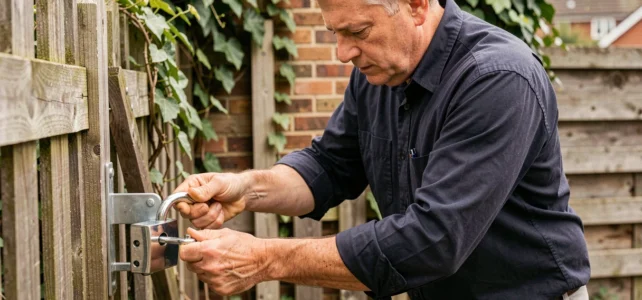
A double locking padlock requires a key on both sides to open and close. Unlike a standard lock with an interior button, it eliminates the possibility of unlocking without a key. This feature is a game changer for security, but also for everyday use. Before drilling any holes, you need to know if this type of padlock is really suitable for your situation.
Double locking padlock and installation support: the trap that few anticipate
Have you ever tried to attach a padlock to a softwood shed door? The padlock may be sturdy, but the weak link remains the support. A double locking mechanism protects against picking and manipulation of the cylinder, but it does not reinforce the door, gate, or grille on which it is installed.
On a thin sheet metal gate, a burglar will not attack the padlock. They will bend the sheet metal or rip off the mounting plate. The padlock is only as good as its support. This is the first question to ask before purchasing.
For a steel garage door or a welded grille, the double locking mechanism makes perfect sense. For a wooden shed door or a lightweight gate, a well-installed single lock on a metal reinforcement will be more effective. If you are looking to install a secure padlock on a fragile support, start by reinforcing that support with a bolted steel plate.
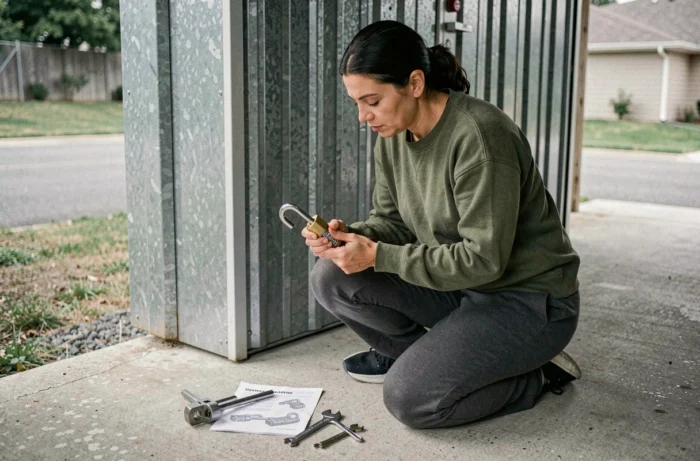
Emergency and forgotten key: when double locking becomes a problem
A double locking padlock requires a key to open from both the inside and the outside. In a space where no one is locked in (garden shed, container, storage box), this is not an issue.
However, on a cellar door accessible from inside the house, or on a gate you pass through several times a day, the absence of an interior button slows down every passage. In an emergency (fire, need for quick evacuation), not finding the key can create a dangerous situation.
When to prefer a simple locking mechanism
- Door leading to a living space or frequently traversed: a lock with an interior rotary button allows for immediate exit without a key
- Shared space among multiple people: multiplying key copies for a double cylinder increases the risk of loss and replacement costs
- Area subject to fire safety inspections: some local regulations require keyless opening from the inside
If you are unsure, ask yourself one question: can someone get locked behind this padlock? If yes, the double locking mechanism is not suitable.
Installing a double locking padlock: materials and concrete steps
Once the choice is validated (solid support, no risk of locking someone in), installation remains accessible. There is no need to call a locksmith if the support is already drilled or equipped with a hasp.
What you need before starting
- A hardened steel hasp, suitable for the thickness of the door or gate. The hasp is the metal piece that receives the shackle of the padlock
- Stainless steel through bolts or screws. Short screws screwed only into wood can easily pull out
- A drill with a metal bit if the support is steel, or a wood bit for a reinforced wooden door
- The double locking padlock itself, with at least three keys provided (to account for loss)
Correctly fixing the hasp
Place the hasp at chest height for comfortable use. Align the two parts of the hasp on the frame and the door leaf, ensuring that the shackle of the padlock fits without forcing once the hasp is closed.
Drill the fixing holes. If the door is wooden, drill all the way through and use bolts with an interior backing plate. A simple three-centimeter wood screw will not withstand a crowbar.
Tighten each bolt progressively, alternating (like for a car wheel) to distribute the pressure. The hasp should not wobble or pivot once fixed.
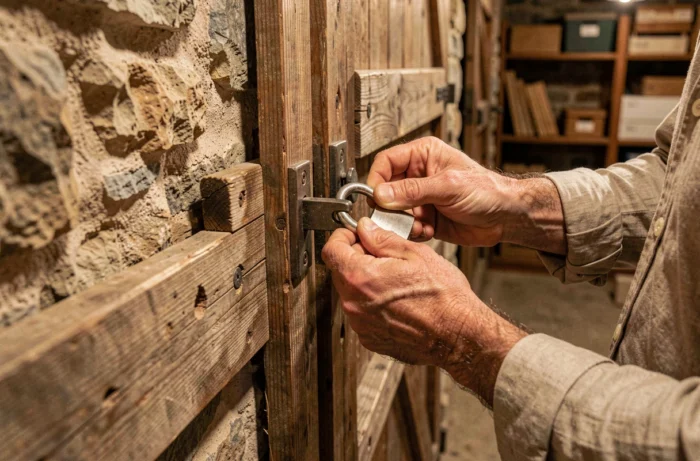
Testing the padlock before closing
Insert the padlock, close it, then open it several times with each provided key. Check that both cylinders turn without forcing. A stiff cylinder indicates a misalignment of the hasp or a defective padlock.
Lubricate the cylinders with a dry graphite spray. Regular oils attract dust and clog the mechanism within a few months, especially outdoors.
Maintenance and lifespan of a padlock exposed to the elements
A padlock installed outdoors is subjected to rain, frost, and temperature fluctuations. Even a treated steel model will eventually seize up if not maintained.
Every three to four months, apply dry lubricant (graphite or Teflon) in each keyhole. Avoid WD-40 in the long term: it degreases but does not provide lasting protection.
Replace the padlock as soon as the key turns stiffly despite lubrication. A worn cylinder becomes vulnerable to picking. It is better to replace a padlock in time than to force it every day and risk breaking the key inside.
If the shackle of the padlock shows signs of tampering (deep scratches, saw marks), do not just replace it. Reassess the entire setup: the hasp, the mounting, and the strength of the support. A burglar who has failed once will return better equipped.
The double locking padlock remains a reliable security tool for uninhabited premises and infrequently accessed areas. On a solid support, properly installed and maintained, it deters most attempted break-ins. For doors you pass through daily, a single cylinder lock with an interior button offers a better compromise between protection and practicality.